All projects

Kijiji Banner Ads

A self-serve display ad platform: businesses build or upload banners, target an audience, pay with Stripe and run on Kijiji through Google Ad Manager.

Ad Tech

  • typescript
  • react
  • primereact
  • nodejs
  • mysql
  • aws lambda
  • aws cognito
  • aws s3
  • stripe
  • google ad manager
Kijiji Banner Ads on a laptop
Kijiji Banner Ads on a tablet
Kijiji Banner Ads on a phone
The Kijiji Banner Ads interface.

Overview

Kijiji Banner Ads is the Kijiji edition of Clarity Banners, GSI's multi-network self-serve display advertising platform. Small businesses build banner ads from templates or upload their own, choose where and to whom they run, pay online, and launch campaigns on partner networks such as Kijiji in Canada and GSI AdCloud / Trader Interactive. Approved campaigns are pushed to Google Ad Manager automatically, and delivery stats flow back into the advertiser's dashboard. One repository holds five parts: a Node.js backend on AWS Lambda, the advertiser portal and admin console, a separate console for Trader Interactive, a visual scraping robot builder, and the SVG banner template engine. The backend's environment and credentials are no longer valid, so the screens shown here are the real React frontends running locally, with API responses replaced by sample data.


Screens

Advertiser portal

  • Kijiji Banner Ads, the template editor screen
    Template editor A template customised in a live editor that previews every banner size at once
  • Kijiji Banner Ads, the targeting screen
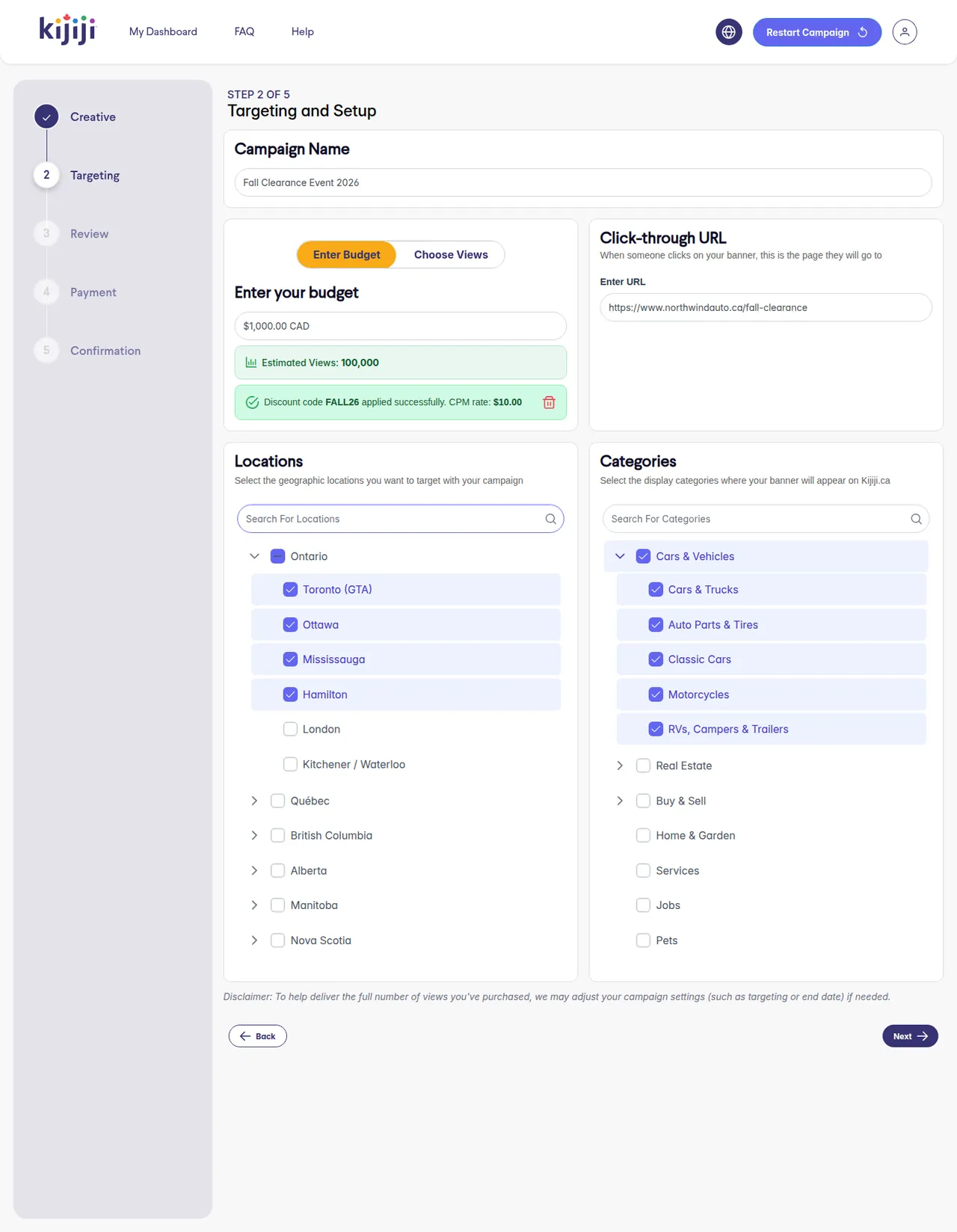
    Targeting Budget or views, location and category trees, click-through URL and a discount code
  • Kijiji Banner Ads, the review screen
    Review The pricing summary with CPM, discount and provincial tax before payment
  • Kijiji Banner Ads, the campaign screen
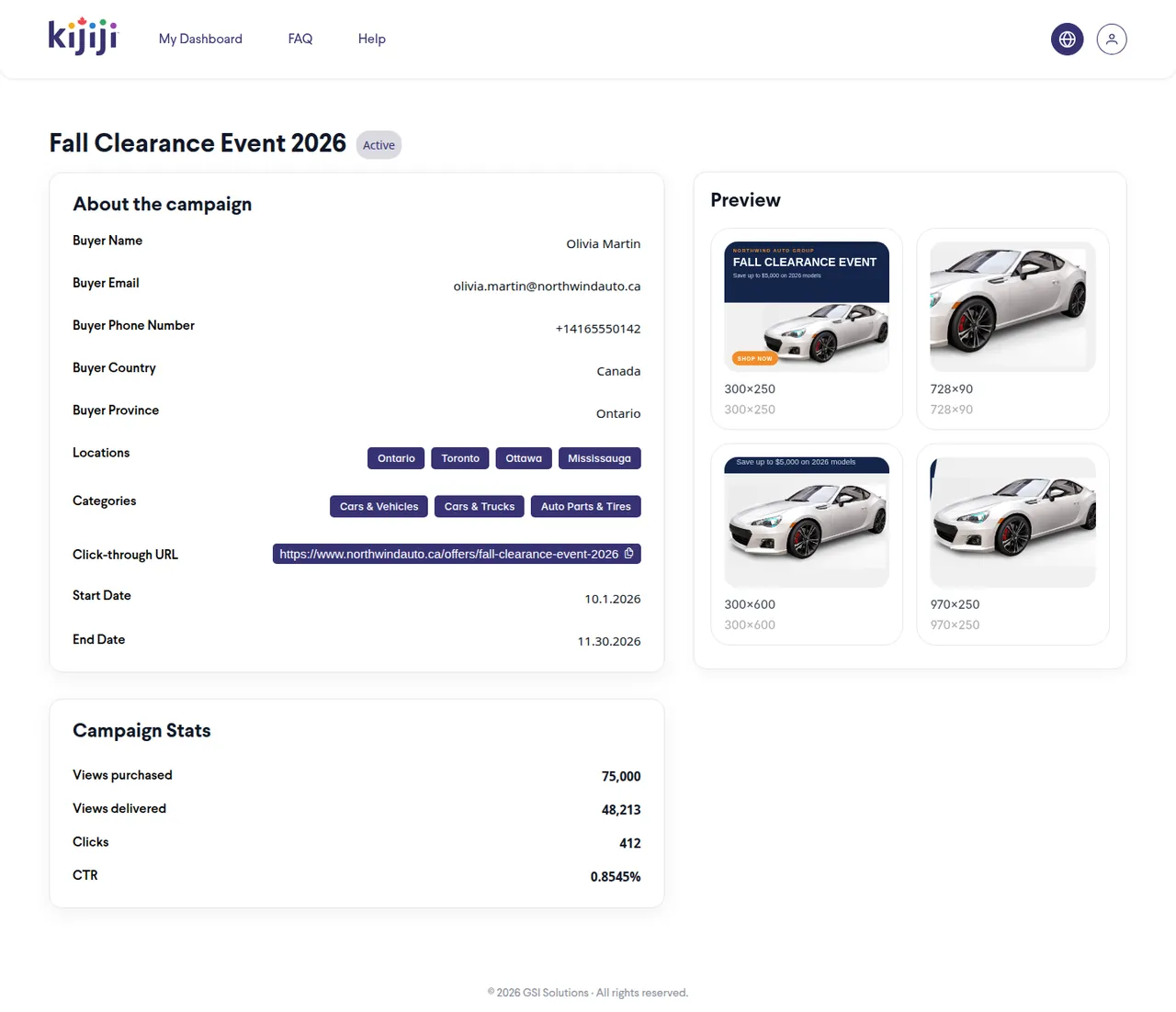
    Campaign An active campaign: buyer details, targeting, flight dates and its creatives

Admin console

  • Kijiji Banner Ads, the moderation screen
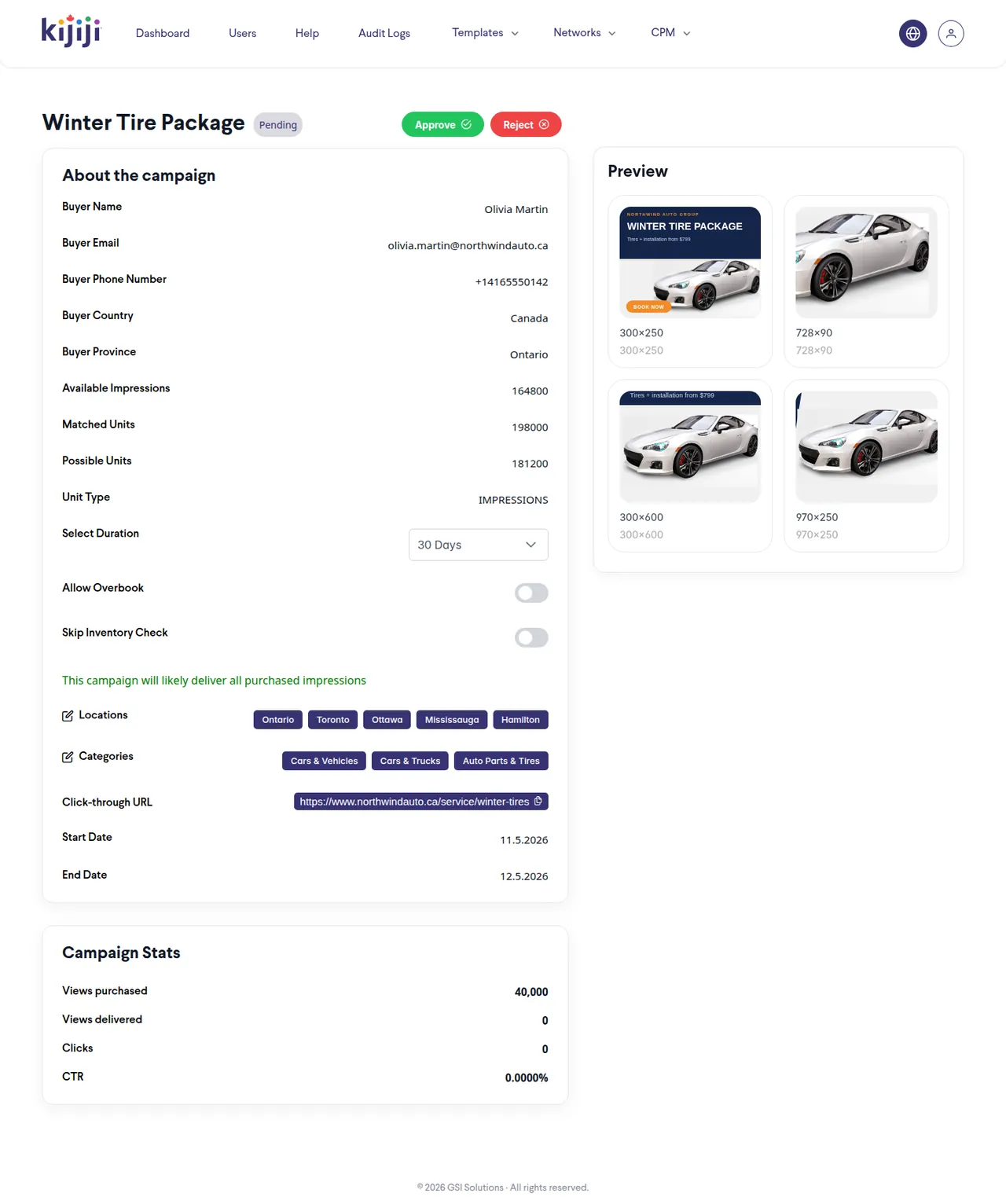
    Moderation A pending campaign reviewed against the Google Ad Manager forecast, then approved or rejected
  • Kijiji Banner Ads, the discount codes screen
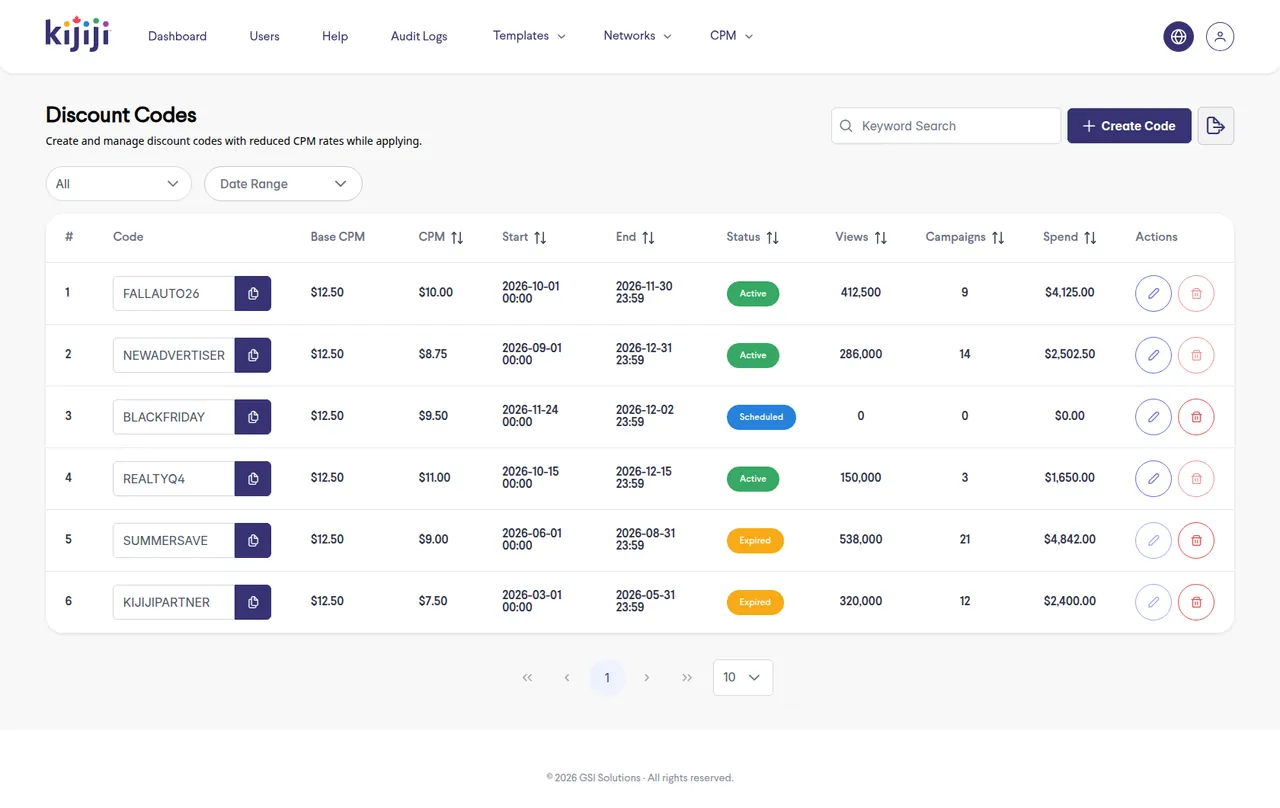
    Discount codes Discount codes with their CPM, schedule and usage

Dynamic ads

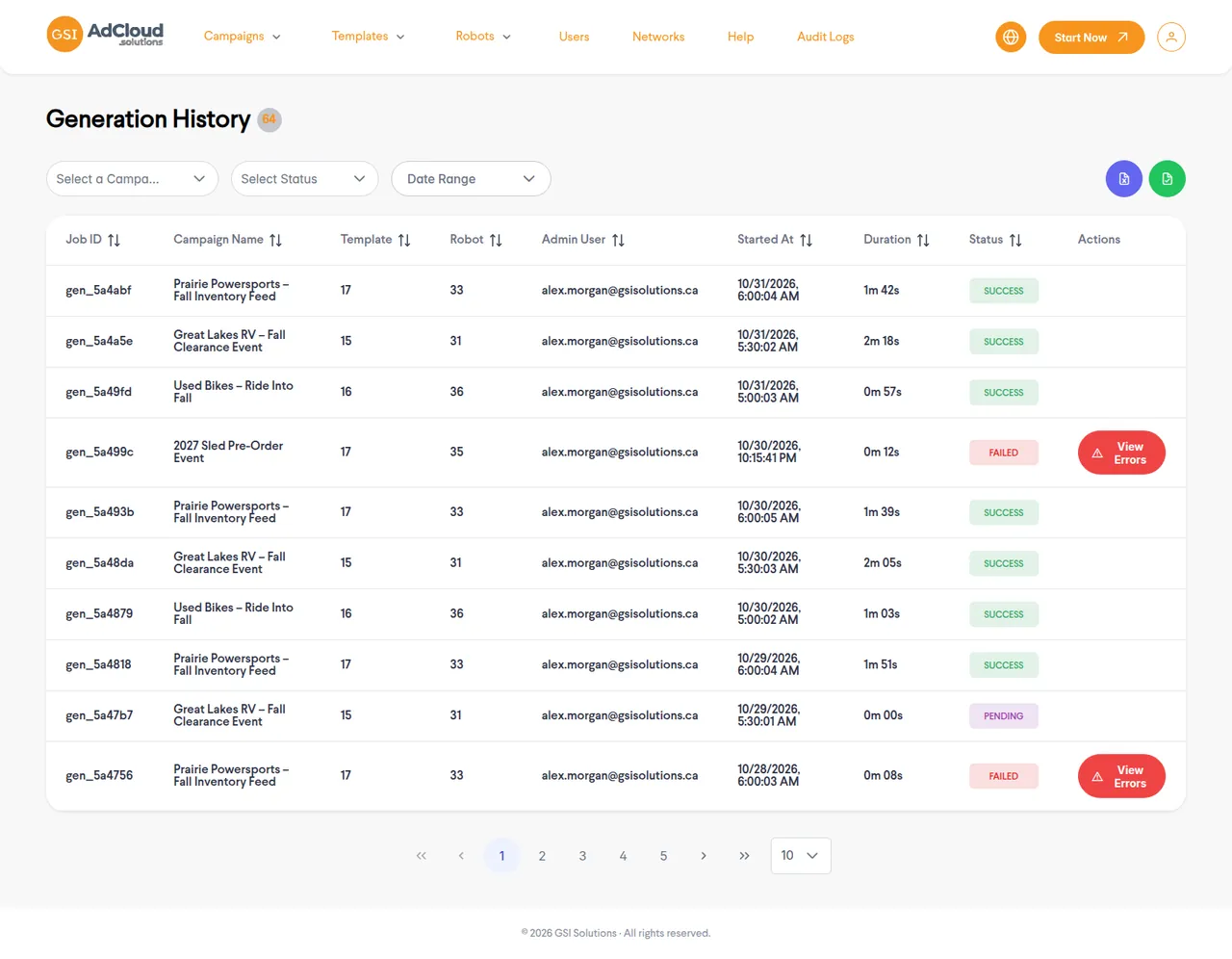
  • Kijiji Banner Ads, the generation history screen
    Generation history Each banner generation run, with its robot, template, duration and result
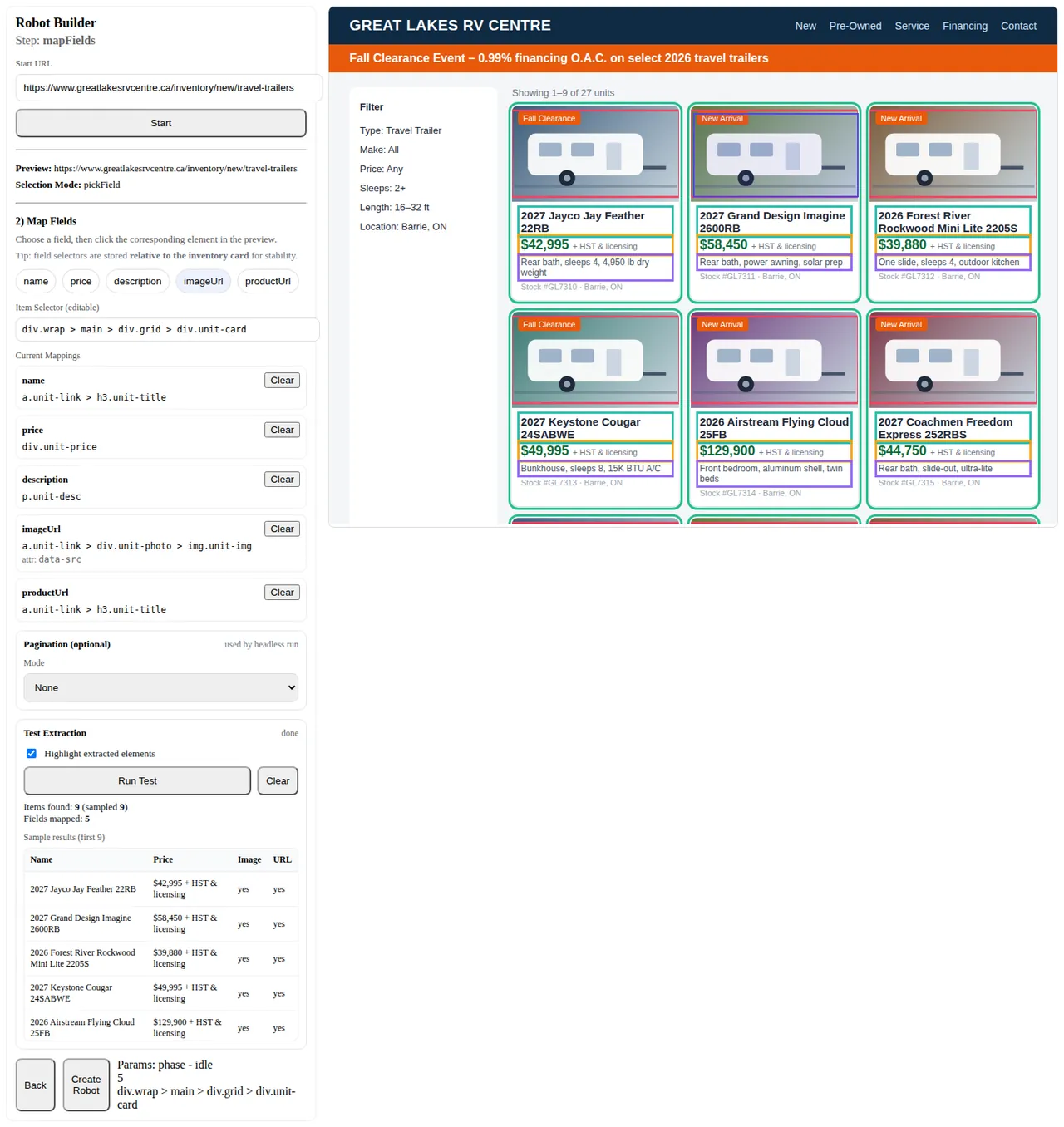
  • Kijiji Banner Ads, the robot builder screen
    Robot builder Mapping a dealer page's inventory fields by clicking them, before the robot is created

Key features

  • Two ways to create a campaign: upload JPG, PNG or GIF banners at IAB sizes (970×250, 728×90, 300×250, 300×600), detected from their pixel dimensions, or build one from a template.
  • Template ads are customised in a live multi-size SVG editor (text, colours and images) and exported to PNG in every size.
  • A guided wizard runs Creative → Targeting → Sign-up → Review → Payment → Confirmation, and keeps the draft across page reloads.
  • Targeting by location (province → city) and category trees, with either a CAD budget or a number of views from 25k to 300k.
  • CPM pricing with scheduled promotional rates and discount codes; Canadian GST/HST and US state sales tax are worked out from the buyer's province or state.
  • Stripe pre-authorises the card at checkout and charges it only after a moderator approves the campaign.
  • A campaign dashboard with filters, sorting and live delivery stats (views, clicks, CTR) from Google Ad Manager; pending or rejected campaigns can be edited and resubmitted, and completed ones renewed.
  • Moderators approve or reject with a reason, cancel, extend end dates, and check the Google Ad Manager inventory forecast before approving.
  • Admins manage the template library (SVG, HTML and carousel templates with a draft/published workflow), CPM rates, discount codes, users, networks and audit logs.
  • Dynamic ads for Trader Interactive: scraping robots read dealer inventory (RV, marine, powersports) and the products are merged into templates to generate banners, an XML feed and a carousel.
  • English and French interface, and a Zoho Desk support-ticket system with attachments and threaded replies.

Engineering highlights

  • A single AWS Lambda handles HTTP requests, SQS messages, EventBridge schedules, Stripe partner events and Cognito triggers, each routed to its own entry point.
  • Approved campaigns become Google Ad Manager orders, line items and creatives through the GAM API; a scheduled job syncs delivered impressions back.
  • Pricing follows one formula: effective CPM is the promotional or platform rate minus the discount, the subtotal is views ÷ 1000 × CPM, and provincial or state tax is added before the Stripe pre-authorisation.
  • The backend uses a custom Node.js 22 MVC framework without Express, with a declarative route table that enforces Advertiser, NetworkAdmin, PlatformAdmin and SuperAdmin roles.
  • Every frontend follows a strict MVVC pattern: a ViewController owns state and handlers, and the View stays presentational, calling the API through services and a shared REST client.
  • Each network gets its own branded theme, selected by an environment variable at build time.
  • The robot builder loads a sanitised copy of the dealer page in a sandboxed iframe, so selectors can be picked by clicking and tested with highlights before a Browse AI robot is created.
  • Uploads go to S3 through presigned URLs; sign-in uses the Cognito Hosted UI with PKCE; forms are validated with react-hook-form and Zod.

Challenges and approach

Advertisers pay up front, but a campaign may still be rejected by a moderator.

Checkout only pre-authorises the card with Stripe; the charge is captured when the campaign is approved, and a broken-payment tool lets admins look up and recover payments that went wrong.

A moderator could approve more impressions than the network can actually deliver.

The review screen shows the Google Ad Manager inventory forecast next to the requested views, with explicit overbook and skip-inventory-check switches for exceptions.

Dealer inventory changes constantly, so hand-made banners for each listing would go stale.

Scraping robots pull the inventory, mapped fields feed a generation job that merges products into templates, and a history view records each run's success or error.